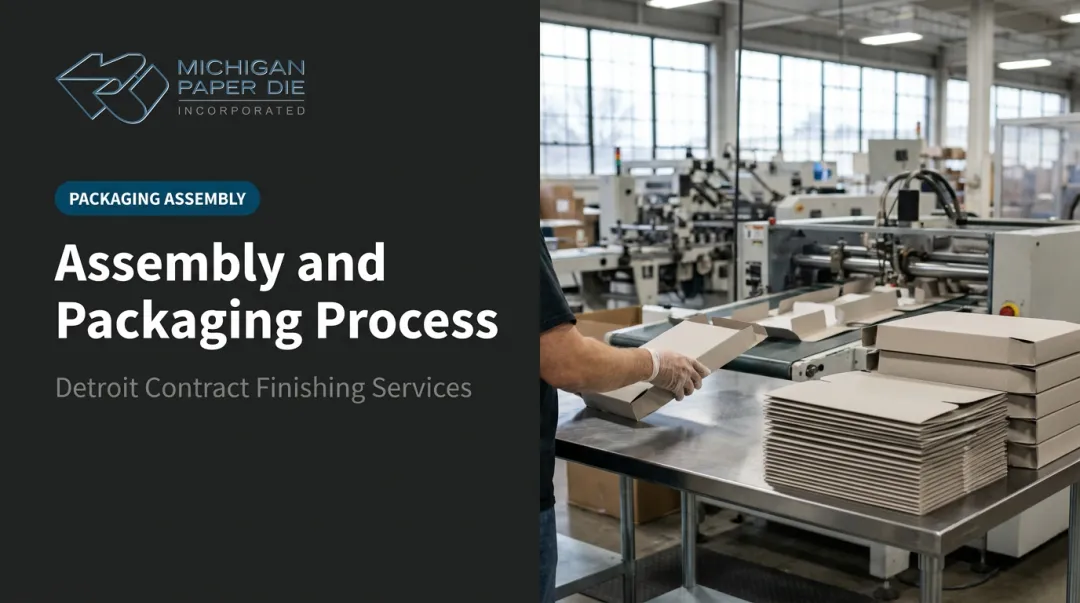

Introduction
A die-cutting machine can punch out a thousand carton blanks in the time it takes to read this sentence.
What it can't do is nestle tissue paper into a gift box, tie a ribbon at just the right tension, or catch a misaligned insert before it ships to your biggest client.
That's where hand assembly comes in.
Many businesses struggle to find a finishing partner who can handle intricate, multi-component packaging without blowing the budget or the deadline. Complex folding cartons, promotional kits, and retail displays often need a level of judgment that automated lines simply weren't built for.
This article breaks down what hand assembly services actually involve, when your business needs them, and how the terminology (hand-assembled, handmade, handcrafted) gets confused.
We'll also look at how Michigan Paper Die's hand bindery department, which represents nearly a third of its business, handles this work for brands across Metro Detroit and beyond.
Key Takeaways
- Hand assembly means manually joining pre-made components, not building products from raw materials
- Short-run or highly customized packaging often needs hand assembly, since automation isn't cost-effective
- Detailed quality control reports separate a dependable hand assembly partner from a risky one
- Michigan Paper Die's hand bindery generates about 30% of revenue, backed by decades of on-time delivery
What Are Hand Assembly Services?
Hand assembly is the manual process of joining pre-made, pre-cut, or pre-printed components into a finished product. Think of it as a finishing step, not a manufacturing one. The paperboard has already been printed. The die-cutting is done. What's left is putting the pieces together, and that's where trained hands take over.
According to MSL's overview of manual assembly in contract packaging, the work covers folding, gluing, inserting components, labeling, kitting, and final inspection — all performed by people rather than a fully automated line.
It's downstream work. The raw materials became components somewhere else; hand assembly turns those components into something a customer can actually use.
Common Tasks Performed Through Hand Assembly
Most hand assembly work falls into a handful of recognizable categories:
- Folding carton assembly — closing and locking cartons with multiple tabs or panels
- Insert placement — tissue paper, dividers, foam, or protective liners
- Attachment work — ribbons, handles, or decorative elements
- Multi-piece box construction — gift boxes and presentation packaging with separate lids, bases, and inserts
- Kitting — assembling promotional materials, sample packs, or welcome kits into one cohesive package

Hand assembly also shows up early in a project's life, well before full production begins. Prototypes and short-run test batches almost always get built by hand first, so a team can catch design flaws before committing to tooling or automated setup.
Hand Assembly vs. Automated Assembly
Automation wins at repetition. If you're producing 50,000 identical cartons with no variation, a gluing machine will outperform a person every time. Hand assembly wins when the job is small, delicate, or constantly changing.
Setup time is often the deciding factor. On short folding carton runs, repeated makereadies can eat the entire job's profit margin.
According to PostPress's reporting on short-run carton production, carton runs of 500 to 1,000 sheets on larger equipment may require 30 to 60 minutes of setup for only 5 to 10 minutes of actual running time. At that ratio, dedicating a machine to a 500-piece job rarely makes sense.
Most experienced finishing houses don't pick one method exclusively. They run what they can through automated equipment and hand off the rest, whether that's an odd-shaped box, a fragile substrate, or a design that changes weekly. Michigan Paper Die's hand bindery department, which accounts for roughly 30% of the company's total work, follows the same logic: automated equipment runs the repeatable jobs, while trained hands step in for small-batch, delicate, or frequently changing work.
When Does Your Business Need Hand Assembly Services?
Certain packaging situations point directly to hand assembly, almost regardless of industry:
- Folding cartons with multiple locking tabs or unusual fold sequences
- Gift and presentation boxes with separate components (lids, inserts, dividers)
- POP and retail displays requiring precise, careful construction
- Corporate welcome kits, training materials, and onboarding packages
Volume matters too. If you're printing 300 units instead of 30,000, investing in automated tooling doesn't pencil out.
Delicate substrates (foil-stamped stock, embossed panels, specialty papers) also tend to resist machine handling. And when a design is simply too intricate for existing equipment, hand assembly becomes the only realistic option.
Industries that lean on hand assembly most:
- Automotive brands producing launch kits and dealer promotional pieces
- Food and beverage companies building retail-ready displays
- Consumer goods brands needing premium, gift-style packaging
- Higher education institutions assembling acceptance or orientation packages
Michigan Paper Die's client roster reflects this pattern directly. Work spans automotive names like Jeep and Audi, consumer brands like Colgate and The North Face, food service clients like Little Caesars, and institutions like Wayne State University.
Key Benefits of Partnering with a Hand Assembly Service Provider
Forcing a complex or delicate project through automated equipment often creates more problems than it solves. Machines don't adapt well to inconsistency, and packaging that's slightly off-spec, fragile, or intricately shaped tends to jam, misalign, or damage on a production line built for uniform pieces. Skilled hands adjust in real time.
A strong hand assembly partner offers:
- Reduced errors on complex jobs: human oversight catches problems automation would push straight through
- Documented quality control: detailed QC reports sent with every job help clients spot issues early
- Cost-effectiveness for short runs: no need to pay for tooling that only gets used once
- Design flexibility: changes and prototype approvals happen before you commit to a full production run
- Brand confidence: you get a finished product you're comfortable putting your name on

That last point matters more than it might seem. When something goes to market with your logo on it, mistakes are expensive in ways that go beyond reprint costs. A provider who documents every stage of production, rather than just shipping a box and hoping it's right, gives you a paper trail if something needs troubleshooting later.
Michigan Paper Die builds this into every job through its Quality First policy. Every hand-assembled project ships with a Quality Control Report that includes production notes, mock-ups, proofs, and pull sheets taken at intervals during the run. This report comes standard with every order, built to help clients catch small issues before they become recurring ones.
Hand Assembled vs. Handmade vs. Handcrafted: What's the Difference?
These three terms get used interchangeably in marketing copy, and that's a mistake worth correcting.
Handmade traditionally means an item is built entirely from scratch, without pre-made or pre-formed parts. Merriam-Webster defines it as something "made by hand or by a hand process" (Merriam-Webster, Handmade), which implies the whole production journey, not just the final step.
Hand-assembled refers to something narrower: manually putting together components that were already produced, often by machine. A folding carton that was die-cut on a Bobst machine and then hand-finished by a skilled worker is hand-assembled, not handmade. "hand-assembled" is the correct term. The paperboard, printing, and die-cutting happened on equipment. The folding, inserting, and finishing happened by hand. Calling that "handmade" overstates the process, and a discerning client or agency will notice the difference.
Michigan Paper Die's Hand Bindery & Assembly Capabilities
Michigan Paper Die's hand bindery department handles collating, poly-bagging, hand-taping, tipping, sorting, and full product assembly. It's grown to represent roughly 30% of the company's total business, a figure the company attributes directly to its reputation for on-time delivery and attention to detail.
That reputation isn't accidental. Every job, hand-assembled or otherwise, runs under the company's Quality First policy:
- Pull sheets taken during make-ready and production for in-process quality checks
- A full Quality Control Report (notes, mock-ups, proofs, conversation records) shipped with every completed order at no extra charge
- Pre-production review of laser proofs and mockups to catch conflicting instructions before production starts
The same standards apply to equipment and capacity, not just paperwork. With more than 40 years of finishing and converting experience, Michigan Paper Die pairs hand assembly with steel-rule die construction, Bobst die-cutting, high-speed gluing, foil stamping, and embossing. All of it happens under one roof at its Detroit facility.

That matters because most real projects aren't purely automated or purely manual. A folding carton might get die-cut and glued by machine, then hand-collated and poly-bagged for shipment. Routing decisions come down to what the material, complexity, and timeline actually require, not a one-size-fits-all rule.
Industries and Brands Served
Michigan Paper Die's hand assembly work has supported major brands across several sectors:
- Automotive: Jeep, Audi, Lincoln
- Consumer goods: Colgate, The North Face
- Food service: Little Caesars, Menchie's Frozen Yogurt
- Higher education: Wayne State University
- Sports: Detroit Lions
The company works directly with design firms, advertising agencies, corporations, commercial printers, and entrepreneurs, on projects that range from single prototype runs to large branded programs.
If you're planning a packaging project that needs a human touch machines can't provide, contact Michigan Paper Die for a consultation. Free quotes are available, and the earlier you bring the team in, the more room there is to test materials and refine the design before production begins.
Frequently Asked Questions
Are "hand assembled," "handmade," and "handcrafted" the same?
No. Handmade means building something entirely from scratch, while hand-assembled involves manually joining pre-made parts. Handcrafted highlights skilled manual work, no matter the starting materials.
What types of packaging projects typically require hand assembly?
Multi-piece gift boxes, promotional kits, POP displays, and short-run folding cartons with intricate locking tabs or delicate substrates all typically need manual finishing.
Is hand assembly more expensive than machine assembly?
It depends on volume and complexity. For short runs or highly custom projects, hand assembly is often more cost-effective since it avoids paying for automated tooling that would only run once.
How long does hand assembly take compared to automated assembly?
Hand assembly usually takes longer per unit. Experienced providers offset this through efficient workflows, upfront planning, and firm turnaround commitments.
Can hand assembly be used for large production runs?
Hand assembly works best for small to mid-volume runs. Hybrid approaches, combining automated die-cutting or gluing with manual finishing, can scale to larger orders.
What industries benefit most from hand assembly services?
Automotive, retail and consumer goods, food and beverage, and higher education all need custom kits and displays regularly. Branded packaging for these industries often exceeds what automation alone can handle.