
Introduction
Ask five people what "assembly and packaging" means, and you'll get five different answers. For brand owners, design agencies, commercial printers, and entrepreneurs sourcing custom folding cartons, that vagueness gets expensive fast.
The assembly and packaging process combines die-cutting, folding, gluing, and finishing operations that turn flat, printed material into a finished, ready-to-ship package or display.
Packaging exists to contain, protect, transport, and sell a product, according to the World Packaging Organisation. Getting there involves technical stages most buyers never see: die construction, cutting, gluing, hand assembly, and quality control.
This article breaks down what the process is, why it exists, how it flows step-by-step, where it applies, and what factors change the outcome.
Key Takeaways
- Assembly turns die-cut blanks into finished cartons via folding, gluing, and bindery
- The core flow runs from prototype approval to die-cutting, gluing, and quality control
- Material caliper, humidity, and equipment access drive speed and cost
- Not every carton needs hand assembly — many jobs go straight to machine gluing
What Is the Assembly and Packaging Process, and Why Does It Matter?
Defining the Process
This process is the sequence of operations (cutting, creasing, folding, joining, finishing) that transforms a printed sheet or die-cut blank into a structurally complete package. The goal is straightforward: a package that holds its shape, protects what's inside, and is ready for filling or retail display.
This differs from die-cutting or printing alone. Die-cutting shapes the blank. Printing puts the graphics on it. Assembly is the downstream stage that finishes what those earlier steps start: the point where a flat piece of board actually becomes a box.
Why It's Essential for Custom Packaging Buyers
Custom packaging projects demand consistency across thousands of units, structural reliability, and brand presentation that matches the design proof. A controlled process is what delivers that.
Without one, common problems show up fast:
- Misaligned glue joints that cause cartons to pop open in transit
- Inconsistent folds from crease lines that weren't positioned accurately
- Shipment damage when structural integrity wasn't verified before the order left the facility
Michigan Paper Die's Quality Control Reports catch these issues before a job ships, logging crease accuracy and glue-joint checks on every run.

In industries like automotive, food and beverage, and retail consumer goods, this level of consistency is largely an operational best practice rather than a formal regulation, driven by brand expectations and quality standards, not by a specific law. Food-contact safety is the exception, where components must meet purity requirements under federal rules. Everything else (how sharp the fold looks, how sturdy the carton feels on shelf) comes down to the converter's process discipline.
How the Assembly and Packaging Process Works (Conceptual Flow)
The end-to-end flow moves from an approved design and die-line file to a finished, quality-checked package. Inputs include printed sheets, steel-rule dies, adhesives, and packaging specs. Die accuracy, machine calibration, and inspection checkpoints control the core transformation (cutting, scoring, folding, gluing, and joining), so results stay consistent whether you're running 500 units or 50,000.
Here's how that plays out in practice.
Step 1: Design, Prototyping, and Die Construction
Before cutting any steel, the team finalizes the die line in CAD software. At Michigan Paper Die, that's done using Cimek CAD, which imports die-line files directly from Adobe Illustrator EPS format to speed up the design stage.
The team then builds a physical prototype on an in-house sample-making table and reviews it internally against the client's specs, laser proofs, and mockups. Only after that prototype is approved does full die construction begin, a step that catches structural problems before they become production-run mistakes.
Step 2: Die-Cutting and Fold Preparation
Once approved, the same digital file that built the prototype drives a CNC router, which cuts the die board with tight tolerances, while an automatic rule-bending machine simultaneously shapes the steel rules that will crease the material.
This matters because even minor deviations in rule placement cause misaligned folds. Using one verified file for both processes keeps crease lines exactly where the design intends, which is what makes a carton fold cleanly instead of buckling at the corners.
Step 3: Gluing and Hand Assembly
Standard folding carton joins run through high-speed gluing machines at volume, including:
- Side seam cartons
- Tuck-type cartons
- Crash lock cartons
- Partition cartons
But not every design fits that mold.
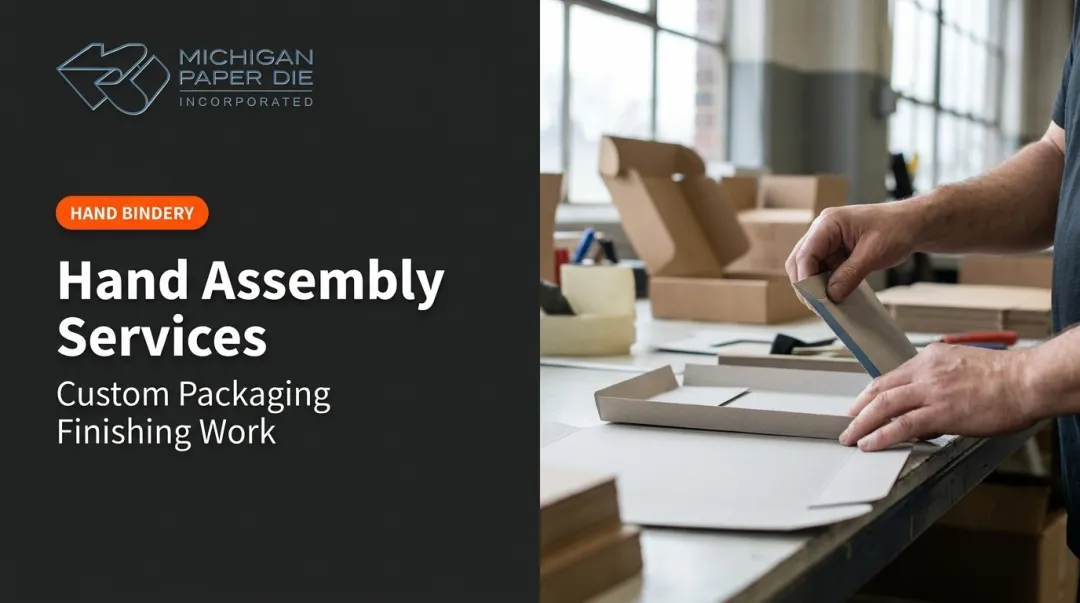
Intricate structures, delicate materials, or unusual folding configurations move to a hand bindery department instead. Staff there handle tasks automated equipment can't replicate, including:
- Collating multi-piece sets by hand
- Poly-bagging finished pieces for shipment
- Hand-taping delicate or unusual seams
- Tipping small components into place
Machines and hand assembly aren't competing methods here; they're matched to the job based on what the design actually requires.
Step 4: Quality Control and Fulfillment
Before anything ships, the team checks finished pieces against the original specifications. Staff pull sheets at intervals during the run (one copy kept in-house, one packaged for the client) and compile them into a Quality Control Report that documents proofs, procedure notes, and communication records for that specific job.

Where the Process Is Applied and What Affects It
Where It's Applied
This process shows up anywhere flat printed material needs to become a functional structure:
- Folding cartons for retail consumer goods
- Point-of-sale displays for in-store marketing
- Presentation boxes for corporate or promotional use
- Kitted packages prepared for fulfillment
It happens after printing and die-cutting, and before shipment or warehousing. Common triggers include a new product launch, a seasonal packaging run, or a rebrand requiring updated carton assembly. Because most brands reorder packaging on a cycle, this is typically a recurring, production-run process — not a one-time event.
Key Factors That Affect the Process
Several variables shift how fast and how well the process runs:
- Material type and caliper: Thicker or stiffer board can require double creasing to fold cleanly
- Ambient humidity: Paperboard is sensitive to humidity changes, which can affect its flatness and dimensional stability
- Temperature: High heat can prolong hot-melt adhesive set time, leading to what the industry calls carton pop-opens
- Equipment dependencies: In-house die construction and multiple gluing machines cut turnaround versus outsourcing each stage separately
- Order volume and run frequency: This determines whether hand assembly or full machine automation makes more financial sense
- Brand and quality constraints: Regulated or high-visibility categories, like automotive or food packaging, often demand tighter tolerances
Common Issues, Misconceptions, and When Full Assembly May Not Be Needed
Common Issues and Misconceptions
A few misunderstandings come up repeatedly with custom packaging buyers:
- "Die-cutting and assembly are the same step." They're not. Die-cutting shapes the blank; assembly joins it into a finished structure with its own equipment and timeline.
- "Every carton can be fully machine-glued." Standard tuck, side seam, crash lock, and partition boxes usually can. Intricate or unusual designs often can't, which is exactly why hand bindery departments exist
- "The prototype is the same as the production run." An early sample may not reflect final tolerances once full-volume production begins, so treat prototype approval as a checkpoint, not a guarantee
When the Process May Not Be Appropriate
Understanding these misconceptions helps clarify when full hand assembly isn't actually the right call. Consider skipping it when:
- The design is simple and high-volume, making it entirely suited to machine gluing
- The run is a small, one-off order that doesn't justify custom die construction; an existing stock die may cover it instead
- Hand assembly is being specified out of habit rather than genuine design complexity, adding cost without adding value
Talking through the actual structural requirements before committing to hand bindery is usually the fastest way to catch this.
Conclusion
The assembly and packaging process takes die-cut material and turns it into something functional: a carton that folds correctly, holds together, and ships without failing. Understanding each stage, from prototyping and die construction to gluing, hand assembly, and quality control, gives buyers a real basis for evaluating cost, lead time, and quality on any custom packaging project.
Working with a finishing and converting partner that builds dies in-house and runs a dedicated hand bindery team, like Michigan Paper Die, helps ensure the assembly approach fits the actual design. It's not just whatever's easiest to default to.
Frequently Asked Questions
What is assembly in manufacturing?
Assembly refers to combining individual components or parts into a finished or semi-finished product, typically through fastening, joining, or fitting operations that follow production and precede shipment.
What is assembly in semiconductors?
In semiconductor manufacturing, assembly and packaging means housing a chip or module — attaching the die, making electrical connections, and encapsulating it for protection. This is a different process entirely from the folding and gluing used in paper packaging.
What are the types of assembly processes?
Common categories include mechanical joining (fasteners, snap-fits), chemical or adhesive joining, and thermal joining. Custom packaging assembly specifically relies on folding, gluing, and hand-finishing operations rather than these broader manufacturing categories.
What is the difference between assembly and packaging?
Assembly is joining components into a finished structure. Packaging is preparing that structure, or product, for shipment, storage, or retail display. The two typically happen sequentially within the same workflow.
What equipment is used in the packaging assembly process?
Core equipment includes steel-rule dies, CNC routers, automatic rule-bending machines, and high-speed gluing machines, alongside manual bindery tools for specialty finishing work that automation can't handle.
How long does the assembly and packaging process typically take for a custom order?
Turnaround depends on die complexity, order volume, and whether hand assembly is required. Working with a partner that has in-house die construction, rather than outsourced tooling, can shorten this timeline considerably.